Targeting Strategies and Options
There are many options and strategies for creating ablation patterns from automatically identified targets. This document explains some of the options and the concepts behind targeting strategies and options, arranged according to pattern type.
Spot Pattern Strategies
The following options are available for spot pattern strategies:
Strategy |
Definition |
|---|---|
Core |
The point furthest from any edge, according to an edge distance transform applied to each identified grain (e.g. Fig. 8). |
Rim |
A spot placed near the rim of the identified grain, near the intersection of the axis selected in the options (Table 2). |
Random |
A spot placed randomly within the identified grain. |
Core then rim |
A spot placed using the same approach as core, and then if there is space, a spot placed near the rim of the grain. |
Moment |
A spot placed at the naive centroid (avg x and avg y values) of the grain (e.g. left panel in Fig. 8). The fastest spot placement option. |
Fill |
A grid of spots that fill the grain boundaries, according to the options outlined below (Table 2). |
Along axis |
A one or more spots placed evenly along the major or minor axis of the grain, or along a random axis through the grain. The axis and number of spots are set in the options (Table 2) |
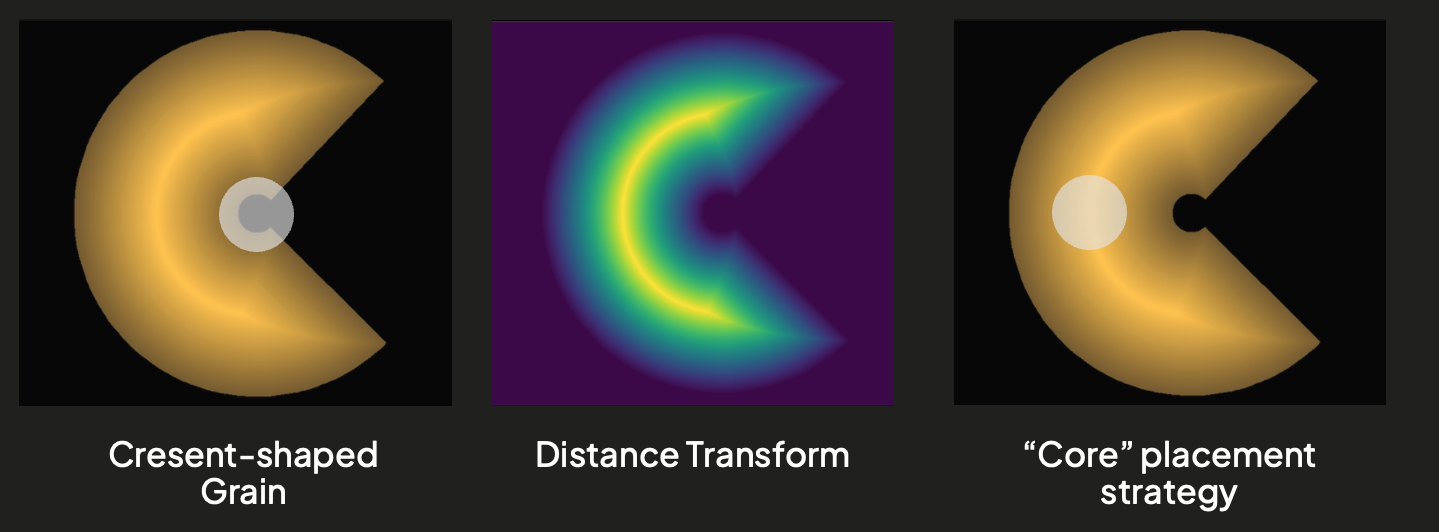
Fig. 8 An example showing the difference between the Core and Moment targeting strategies. For this example crescent-shaped grain, a spot placed in on the centroid (mean x/mean y) of the shape (grey circle in left panel) may overlap non-grain area. The “Core” strategy creates an edge distance transform (middle panel) that calculates the distance from any edge. Placing a spot on the maximum value of the edge distance transform should ensure that the spot overlaps only the grain of interest (grey circle in right panel).
Depending on the strategy chosen, different options will appear in the options.
Option name |
Definition |
|---|---|
Spot size (µm) |
The size of the spot patterns to be placed. |
Number of spots |
The number of spots to be placed. This is the maximum number of spots that can be placed, depending on the size of the grain. |
Axis |
Which axis to place spots along. The major axis is the longest axis through the identified grain shape. The minor is the shortest axis (see Fig. 9). Random is a randomly oriented axis through the grain shape. |
Placement |
Arrangement pattern for a spot grid for the “Fill” strategy. Either “Rectangular”, “Hexagonal”, or “Random”. |
Spacing (µm) |
The spacing between spots in a spot grid using the “Fill” strategy. |
Avoid Inclusions |
When enabled, spot created with the “Core” strategy will only be placed in the solid parts of the grain, avoiding any holes or inclusions. When disabled (default), spots can be placed anywhere within the outer boundary, ignoring internal holes. |
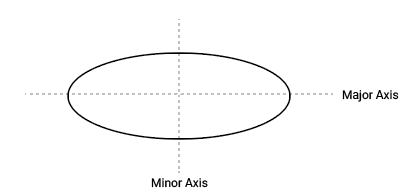
Fig. 9 The major and minor axes of an elongate grain shape.
Tip
Calculating the edge distance transform for each identified grain using the “Core” strategy can be time consuming, but ensures that the spot is placed as much as possible over the grain. Similarly, the inclusion avoidance algorithm can increase calculation time, but avoids holes and inclusions. It might be worthwhile to calculate the Core strategy without the inclusion avoidance turned on to check the results before turning it on.
Line Pattern Strategies
For line patterns a line pattern will be placed along the major, minor (see Fig. 9) or a random axis through the grain outline. The only option is the spot size.
Raster and Lasso Pattern Options
For Raster and Lasso patterns, the only strategy is to cover the identified grain. The options include the buffer and epsilon values.
When used with raster or lasso patterns, the buffer is how far (in µm) to extend the raster/lasso area outside the targeted shape’s boundaries. For example, a buffer of 5 will extend the raster/lasso’s boundaries 5 µm outside the grain’s boundaries.
The epsilon value is a shape simplification factor used when creating raster patterns using a flood fill process (such as finding grain boundaries from a grain’s centre point). For example, simplifying a six-pointed star shape would start to round off the star’s points, with increasing epsilon values eventually simplify the star to a circle.